
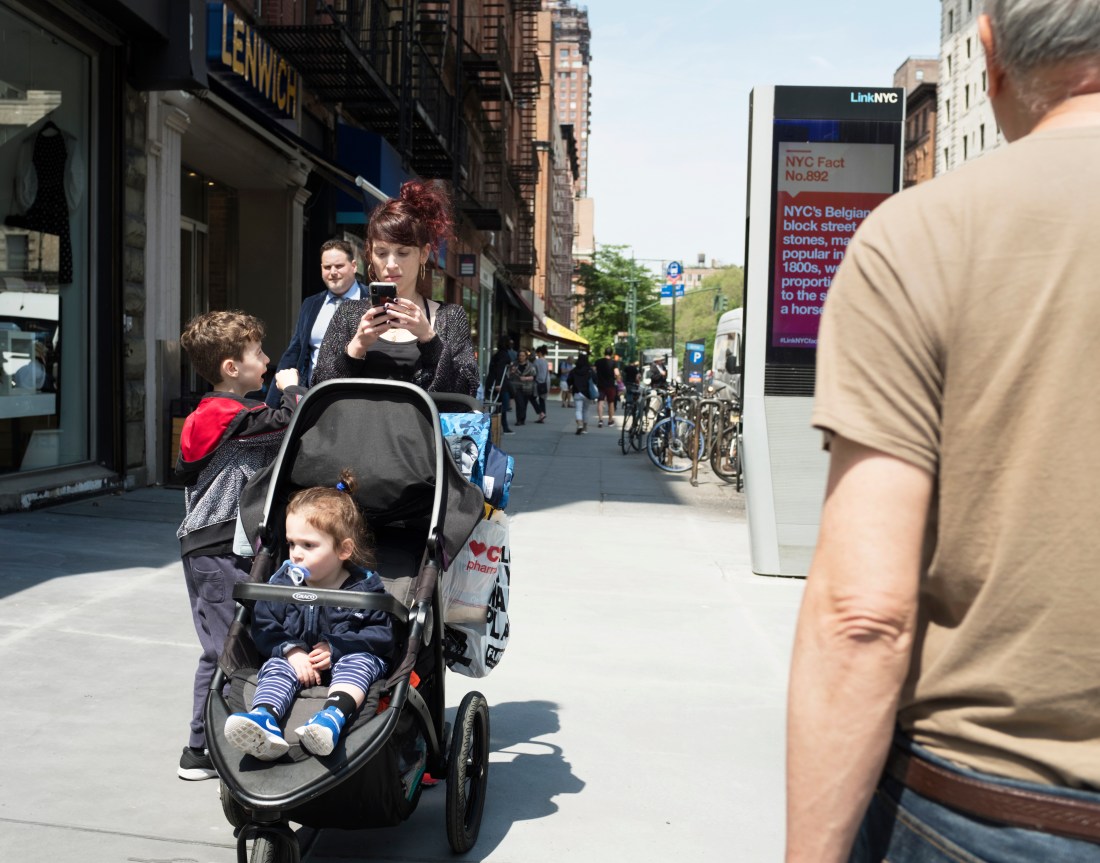
“Tumblr is old news”, my kids would say upon seeing the title to this post. In fact my young son thinks blogging (and for that matter e-mail) is out dated. What is considered cool or acceptable changes over time and one must take into consideration such changes.
I am seeing that this concept also applies to photography on the street. I have been known to photograph the streets of New York and have been doing so since the mid 1990’s. This was way before the internet, iPhones and social media. With the rise of such technology and platforms the implications of having your picture taken by a stranger on the street has changed. The internet is forever as they say.
So then, are photos like the one I am sharing above acceptable practice anymore? Yes they are in public and so have no reasonable expectation of privacy. But then, say I post the photo and the woman is in fact a Nanny, her boss sees the pic on my blog and fires the Nanny because she thinks she is not doing her job properly. I did not have to worry about this 30 years ago, now I do.
In France there is a law prohibiting the taking of photos without the subjects permission. It is supposedly the harshest such law on the books. “Everyone has the right to respect for his private life,” states Article 9 of France’s civil code.
My beautiful daughter hates having her picture taken. She refuses to let her friends tag her in photos and will scream if someone even points a camera in her general direction. It’s not that there are no pictures of her in the digital social landscape, it’s more that she wants as much control over how and who sees her in the electro-social environment. Although I think it is a little extreme there is a logic to her anxiety.
This desire for control has implications. As any photographer that practiced in the wake of 9/11 can attest, there were many over zealous guards and police offers all to eager to tell you not to photograph on the subways or that you couldn’t shoot that building or bridge. Even now when I am photographing reflections in car windows I have had many angry encounters with car owners demanding I delete the picture I have taken or asking why I am interested in their particular vehicle. Usually after I explain what I am doing and show samples of my work things calm down but once in awhile I have had to, shall I say, assert my dominance. Luckily that is a very rare occurrence. Although once, I must admit, had to scurry away for fear of being beaten senselessly.
Is it moral to photograph someone in the fashion of Cartier-Bresson or Gary Winnogrand anymore? Is the idea of the Decisive Moment out dated? Is a conversation absolutely necessary now for every encounter? I tend think not. The duty of photographs to bear witness to the past and to bring it forward I think would outweigh this.
Last year, France’s new minister of culture, Aurélie Filippetti, promised that she would look into revoking Article 9. She has argued that it was unacceptable to prevent professional photographers from sharing their vision of the world with future generations.
But a little respect goes a long way in the street.
 Force Of Seeing