
Up until 2008 I was a film photographer. Not that I had any choice as digital photography didn’t take off until around that time. My first “real” camera was a Rolleicord TLR which I traded up shortly thereafter to a Rolleiflex. The Rolleiflex was a professional camera (not that I was anywhere near to a professional level) and the Rolleicord was geared towards amateurs (more or less). Aside from a few years shooting with a Nikon F3 and then in the early 2000’s a Leica M7 (I miss that camera) most of my film cameras were square format; Hasselblad 500CM, Rollei SL66, Mamiya 6MF (God I loved that camera). I also shot large format 4×5 film which, compared to 35mm, is rather square-ish. My first digital camera was a Nikon D70 which boasted a 6 megapixel DX sensor. Through the years I have worked my way up the Nikon camera ladder to a Nikon D850 and currently a Nikon Zf (it’s a fun camera) and in my pocket a Sony RX1RIII with a 60 megapixel sensor. In the digital era all my images were in the rectangular 35mm format.
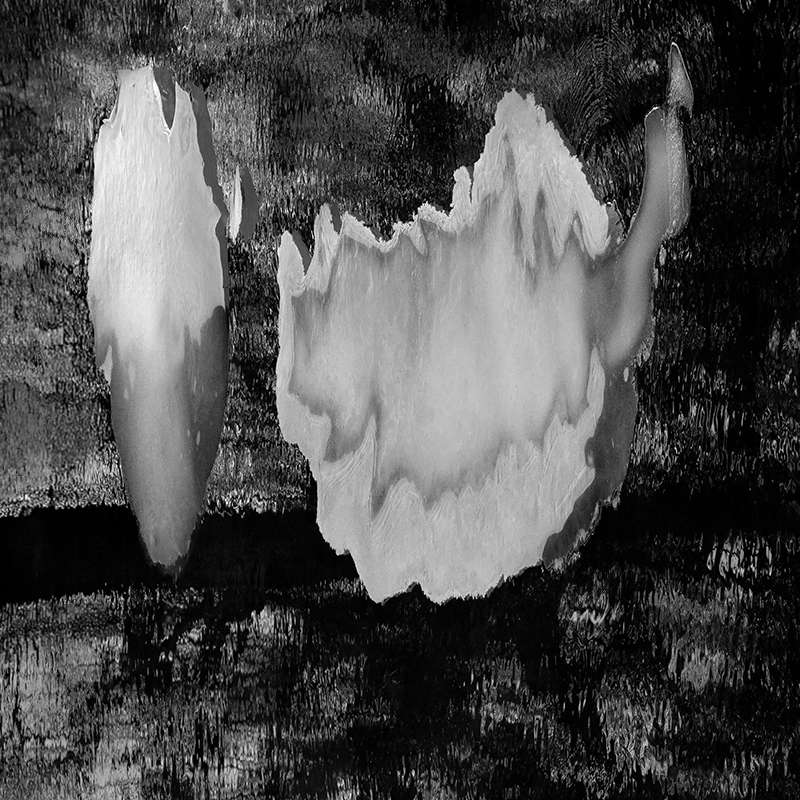
Recently, I was walking in my local parking after the big winter freeze and was dazzled by the ice on the pond. Being (practically) an acolyte of Minor White I could see all of the abstract images that were possible. I took out my trusty Sony (see above), set it to black and white and began exploring. None of the images felt quite right to me until I remembered that this camera gives you the option to shoot 1:1 aspect ratio (i.e. square). Suddenly all the elements in the image fell into place. I was once again that younger photographer, exploring the landscape of equivalence.
I think once I started shooting digitally up until the past few years most affordable cameras didn’t have the megapixels to allow you to chop off the sides to make a square image. I think the first camera that had a large enough sensor to allow you to do this was the Nikon D850. It had an option to choose 1:1 aspect ratio and it had the megapixels to give you a decent square resolution.
I think there are two main advantages to the square format. The first is that there is no real vertical in square format. When I was a magazine photographer every time you went out on a shoot you had to think about a potential cover image which had to be a vertical image. Every time I thought I had a good shot horizontally I would then need to reinterpret it as vertical if I thought it would make a good cover image and thus I had to rotate the camera. Not a big deal but not needing to think about vertical images was a slight relief when shooting square.
Secondly, the square isn’t how we perceive the world. Our vision is horizontal. A square image just emphasizes the fact that it is a piece of the world. It is a copy. The photo is not the world. It is a 2 dimensional and in this case, square, interpretation of what I have perceived. I experimented a little using the square format for the Nocturnes series.
Speaking of Nocturnes, last night I unfortunately found my self heading to Hoboken terminal in New Jersey in order to catch a train to get home to Maplewood. It seems Amtrak and NJ Transit were having one of their perennial meltdowns and service outages. The next train to my home town would not leave for an hour after I reached the terminal and so I decided to take a little walk to the pier. You can see the New York skyline form there and since it was evening and dark I thought it a good opportunity to work on Nocturnes. The only good image I got was this (and yes I was in my square mood):
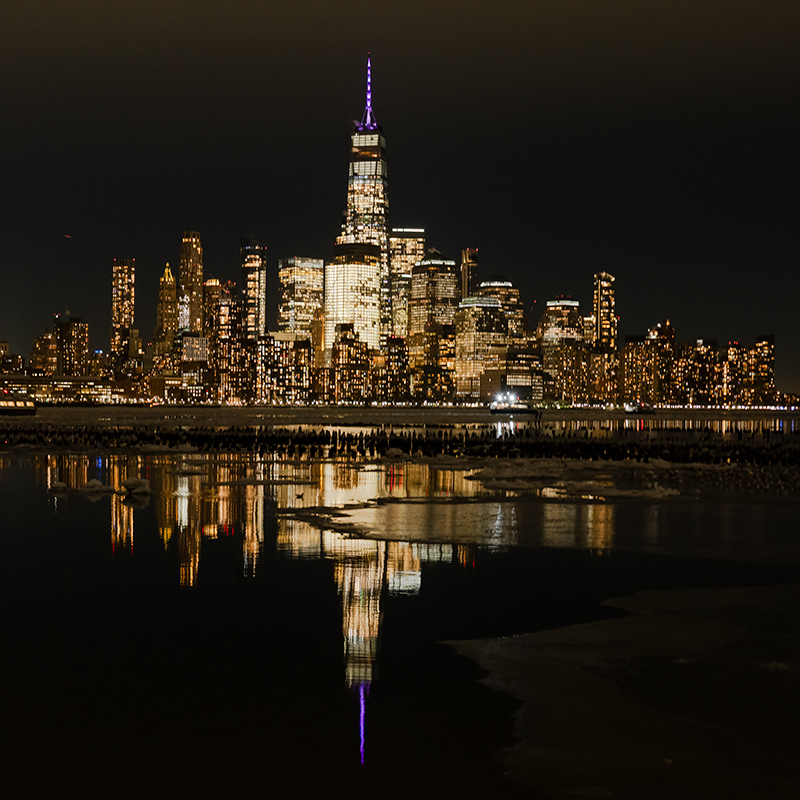
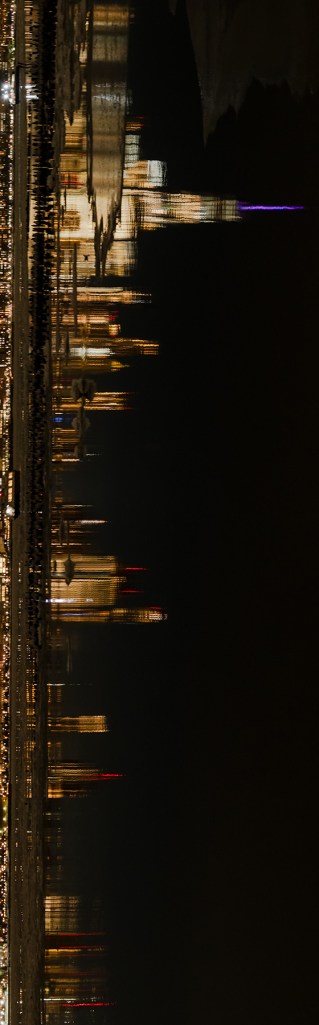
But it was a little too obvious. Anyone walking up to this scene would take something similar. And so I walked around a bit and experimented. Almost everything I attempted failed and then I started thinking about Alice Sara Ott playing the piano and imagined a piano with keys made of light:
 Force Of Seeing